
 Phone
Phone Email
Email


Wooden Trophy Base: The Complete Guide to Design, Materials & Customisation
A wooden trophy base is far more than a structural component — it is the foundation that gives any award its visual weight, perceived value, and lasting impression. Whether you are designing recognition pieces for an annual gala, a sales championship, or a long-service milestone, the choice of base material and construction directly shapes how recipients and audiences perceive the honour. In the sections below, you will find everything you need to select, specify, and customise the ideal wooden trophy base for your next corporate programme.
Key Takeaways
- The wooden trophy base is the single element that most determines how premium and memorable a trophy feels in the hand.
- FSC-certified materials — particularly FSC beech wood — are now the industry standard for brands that want to communicate sustainability alongside prestige.
- Wooden trophy base design choices (profile, finish, engraving area) should reflect your brand identity, not just generic award conventions.
- Explore our full range of wooden trophies for complete award solutions built around quality wood construction.
- For flat recognition pieces, wooden award plaques offer a complementary format that pairs well with trophy programmes.
Index
- Why the Wooden Trophy Base Is Central to Award Design
- 1. Understanding Wood Species and Their Properties
- 2. FSC Beech Wood: The Sustainable Standard
- 3. Base Profiles and Geometric Forms
- 4. Surface Finishes and Treatments
- 5. Engraving and Personalisation Techniques
- 6. Colour and Inlay Options
- 7. Structural Considerations: Weight, Stability and Assembly
- 8. Combining Wood with Other Materials
- 9. Sustainability Certifications and What They Mean
- 10. Ordering Custom Bases: Lead Times and Minimum Quantities
- How to Adapt Wooden Trophy Base Design to Your Programme Stage
- Conclusion
- Frequently Asked Questions
Why the Wooden Trophy Base Is Central to Award Design
When a recipient picks up a trophy, the first physical feedback they receive comes from the base. Its weight, texture, and edge quality form an immediate sensory judgement about the entire programme behind the award. A well-crafted wooden trophy base signals that the organisation behind it takes recognition seriously — and that signal radiates outward to everyone in the room.
- First tactile impression: The density and smooth finish of quality wood create an unmistakable sense of solidity that acrylic or plastic alternatives cannot replicate.
- Visual grounding: A substantial wooden trophy base anchors the trophy visually, making smaller figurative or abstract elements appear more intentional and refined.
- Brand alignment: Wood textures and tones can be matched or contrasted with corporate colour palettes, allowing a single trophy line to feel custom-designed.
- Longevity on display: Unlike synthetic materials, well-finished wood ages gracefully and rarely looks dated years after the award ceremony.
- Sustainability narrative: Responsibly sourced wood lets organisations tie their recognition programme to broader ESG commitments, reinforcing values at the moment of celebration.
- Engraving quality: Wood accepts laser engraving and CNC routing with exceptional precision, producing crisp lettering and logo reproduction that other materials struggle to match.
A trophy base is not a passive element. It is the physical argument that the recognition programme makes about how much it values the people it celebrates.
1. Understanding Wood Species and Their Properties
Wood species selection is the foundational decision in wooden trophy base design, and each species brings a distinct character. Beech is prized for its uniform grain, consistent density, and exceptional machinability — making it the most widely used species in professional award production. Oak offers a bolder grain pattern and greater natural weight, lending itself to heritage-themed programmes. Walnut delivers deep brown tones and a fine texture that reads as premium with minimal finishing required.
Lighter species such as maple and ash produce paler tones ideal for contemporary or Scandinavian-inspired award aesthetics. They also take colour stains with particular evenness, which is useful when a specific brand colour needs to be echoed in the base. Cherry wood, although less common, develops a warm amber patina over time that some organisations deliberately choose for long-service awards designed to be displayed for decades.
Bamboo, technically a grass rather than a timber, is increasingly relevant in sustainable award production. Its hardness rivals many hardwoods, its grain is visually distinctive, and its rapid regrowth cycle makes it one of the most environmentally efficient base materials available. Understanding these differences before briefing a manufacturer helps ensure the final wooden trophy base matches both the visual brief and the programme's values.
2. FSC Beech Wood: The Sustainable Standard
FSC beech wood wooden trophy base production has become the benchmark for responsible corporate award programmes over the past decade. The Forest Stewardship Council certification guarantees that the timber used in each base originates from forests managed according to strict environmental, social, and economic criteria. For organisations that publish sustainability reports or hold ISO 14001 accreditation, specifying FSC-certified materials in recognition programmes demonstrates consistency between stated values and procurement decisions.
Beech is particularly well-suited to trophy base manufacture because of its isotropic structure — it behaves predictably during machining, drying, and finishing. This consistency reduces production waste and ensures that a batch of two hundred bases ordered for a large conference all present with identical colour, weight, and edge quality. Variability in trophy bases, even subtle variability, undermines the sense of equity that a well-run recognition programme depends on.
The environmental case for FSC beech wood extends beyond certification. Beech forests in managed European growing regions sequester carbon at measurable rates, and the short transport chains from forest to workshop common in Central European supply networks keep embodied carbon in the finished base comparatively low. When combined with water-based lacquers and solvent-free adhesives, an FSC beech wood wooden trophy base can be produced with a substantially smaller environmental footprint than equivalent acrylic or resin alternatives.
Specifying FSC-certified timber in your award programme is not a cosmetic choice — it is a procurement decision that the most rigorous sustainability auditors will scrutinise and reward.
3. Base Profiles and Geometric Forms
Wooden trophy base design begins with the profile: the silhouette of the base as seen from the side. A simple rectangular block communicates clarity and authority, and remains the most widely specified form because it photographs well, stacks efficiently during transport, and never distracts from the trophy element above it. Stepped profiles — where the base rises in two or three horizontal tiers — add visual complexity and are associated with classical award traditions, making them appropriate for long-running legacy programmes.
Tapered and angled profiles introduce a more contemporary vocabulary. A base that is wider at the bottom and narrows toward the trophy fixture creates an upward visual momentum that suits dynamic, forward-looking brand identities. Circular and oval bases are less common in wood than in acrylic, primarily because machining curves in hardwood requires more sophisticated tooling, but they offer a distinctly organic, non-corporate aesthetic that some organisations specifically seek. Free-form or irregular profiles are now achievable through CNC routing and are increasingly requested for design-led industry awards.
Height is a critical but often underestimated design variable. A base that is too shallow relative to the trophy element above it makes the entire piece look unstable. A base that is too tall can dwarf a modest figurative element and produce an awkward composition. As a general principle, the base height should represent between 25 and 40 percent of the total trophy height — enough to provide visual grounding without dominating the piece.
4. Surface Finishes and Treatments
The surface finish of a wooden trophy base determines its tactile quality, its interaction with light, and its long-term durability. Matt lacquer is the most widely used finish in contemporary award design because it preserves the natural grain texture while providing protection against humidity and handling. It photographs without glare, which is important for event photography and catalogue images. Satin finishes occupy a middle ground — slightly more reflective than matt but without the formality of a full gloss, they suit a wide range of organisational contexts.
High-gloss finishes, achieved through multiple coats of polyurethane or UV lacquer, produce a mirror-like depth that reads as luxury on display but shows fingerprints readily in hand. They are best reserved for centrepiece trophies displayed behind glass rather than handled frequently. Oil and wax finishes — the traditional woodworker's approach — leave the surface feeling almost unfinished to the touch while enhancing grain depth; they are particularly effective on walnut and oak bases where the natural character of the wood is the design statement.
Burnt and charred finishes, inspired by the Japanese Shou Sugi Ban technique, are emerging in high-end award design. A controlled surface carbonisation followed by brushing and sealing creates a tactile, darkened surface unlike anything achievable with paint or stain. This treatment pairs exceptionally well with gold or brushed brass metal elements and communicates a level of craft investment that immediately distinguishes a programme from standard catalogue awards.
5. Engraving and Personalisation Techniques
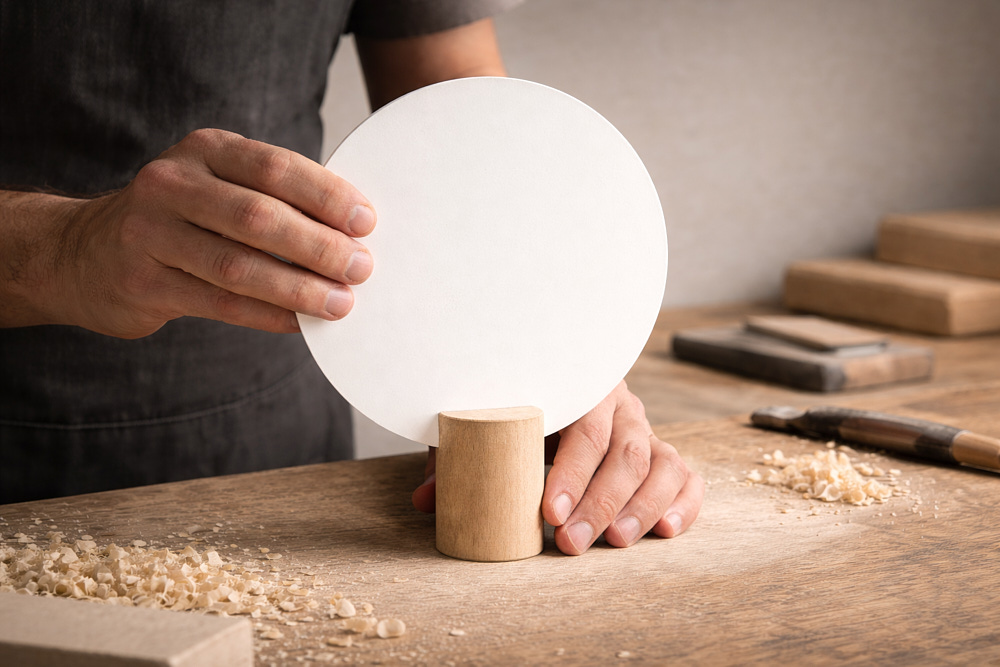
Personalisation transforms a wooden trophy base from a generic product into a named, dated, irreplaceable artefact. Laser engraving is the most precise and cost-effective method available for wood, producing lettering as fine as six-point type and reproducing vector logos at resolutions that exceed what is visible to the naked eye. Modern fibre lasers can vary their depth on a single pass, creating shallow overall logo fills alongside deep-cut text that catches light differently — a technique that adds dimensionality without additional material cost.
CNC routing produces deeper, bolder relief that is more visible from a distance and more tactile to touch. It is particularly effective for large programme logos or emblems that serve as centrepiece design elements rather than small identification marks. Routing also allows the creation of recessed panels — areas where the surface is dropped by one or two millimetres — into which metal plates, resin fills, or printed inserts can be seated flush with the base surface for a more integrated appearance.
Screen printing and pad printing on wood allow the introduction of full-colour elements that engraving cannot achieve. A printed coloured logo combined with engraved text gives a wooden trophy base the visual richness of a multi-process piece while remaining in a cost range accessible to mid-scale programmes. UV digital printing directly onto the wood surface is a newer technique that eliminates the plate costs associated with screen printing and makes even single-copy personalisation economically viable for individual name customisation runs.
6. Colour and Inlay Options
Wooden trophy base design reaches its greatest creative flexibility when colour and inlay options are introduced. Staining wood prior to finishing allows base colour to move from the natural pale honey of beech through amber, warm grey, charcoal, and even deep navy or forest green, depending on the stain chemistry used. Unlike paint, stain penetrates the wood rather than sitting on its surface, which means the grain pattern remains visible beneath the colour — a quality that distinguishes stained wood from painted MDF or resin in both appearance and perceived value.
Metal inlays — strips of anodised aluminium, brushed brass, or blackened steel let into routed channels — are one of the most effective ways to introduce corporate brand colours into a wooden base without compromising its material integrity. These inlays can be used to create geometric accents, border lines, or even typographic elements at a scale and weight that engraving alone cannot achieve. The contrast between warm wood and cool metal is one of the most enduringly appealing material combinations in award design.
Resin fills in routed channels or shaped voids offer a third route to colour introduction. Pigmented resin can be matched to Pantone or RAL references with high accuracy, and its smooth, slightly translucent surface quality is visually distinct from both metal and paint. When illuminated from within using embedded LED elements, resin fills create a backlit effect that is highly effective for centrepiece display trophies at gala dinners or exhibition stands.


Looking for a trophy for your corporate event?
Browse our catalogue
I want a corporate trophy7. Structural Considerations: Weight, Stability and Assembly
A wooden trophy base must perform as a mechanical component as well as an aesthetic one. The primary structural function is to provide a stable, low centre of gravity that prevents the assembled trophy from tipping. This requires that base dimensions be calibrated to the height and weight of whatever is mounted above — figurines, abstract shapes, glass elements, or metal plaques all impose different toppling moments. As a practical rule, the base footprint should be at least 60 percent of the total assembly height to ensure stability without additional ballast.
Fixings between base and trophy element are critical and frequently underspecified. Threaded metal inserts — brass or stainless steel — pressed or glued into pre-drilled holes in the wooden base provide far more reliable long-term fixing than direct wood-to-wood screws or adhesive alone. They allow the trophy element to be removed and reattached without degrading the fixing point, which is valuable for quality control, repair, and in rare cases where engraving errors require a base to be reused. The insert diameter and thread specification must be agreed between base and trophy element suppliers at the design stage to avoid costly remachining.
Base weight can be augmented by specifying a thicker wood blank, by choosing a denser species, or by incorporating a concealed steel plate bonded into a routed recess in the base underside. This last technique is common in high-value trophies where the design calls for a slender profile that would otherwise feel insubstantial. The steel plate adds tactile weight without changing the visible dimensions of the base, maintaining design intent while improving the physical impression the trophy makes when lifted.
8. Combining Wood with Other Materials
Wooden trophy base design gains significant creative scope when wood is combined with complementary materials. The most established combination is wood with metal — typically a polished or brushed aluminium, brass, or stainless-steel plate bonded to the top face of the base to create a clean field for engraving. The metal plate protects the wood from the wear associated with repeated handling and provides a surface whose engraving depth and contrast can be precisely controlled independent of the wood species or finish beneath it.
Glass and crystal elements are frequently paired with wooden bases precisely because the contrast between the warmth and organic texture of wood and the cold clarity of glass produces a visual tension that neither material achieves alone. A clear or frosted glass block mounted on an FSC beech wood base communicates both natural responsibility and technical refinement — a combination that resonates strongly with organisations in the technology, finance, and professional services sectors.
Stone — particularly slate, marble, and granite — can also be combined with wood in award bases. A thin slate tile inset flush into the top face of a wooden base creates a dark, smooth engraving field with a natural material quality entirely different from metal or glass. This combination is particularly well-suited to environmental and conservation awards, outdoor industry recognition, and any programme where the organic and the elemental are central to the brand narrative.
9. Sustainability Certifications and What They Mean
FSC certification is the most widely recognised standard in wood sourcing, but procurement teams evaluating wooden trophy base suppliers should understand the full certification landscape. The FSC Chain of Custody (CoC) certification tracks material from forest to finished product, ensuring that the FSC claim on the final base is supported by documented evidence at every processing stage. A manufacturer who cannot provide a valid CoC certificate number cannot legitimately label their product as FSC-certified, regardless of what the timber merchant they buy from claims.
PEFC (Programme for the Endorsement of Forest Certification) is a parallel certification system that covers many European forests not included in FSC schemes. Both systems are considered credible by the most demanding procurement standards, including those used by FTSE 100 sustainability reporting frameworks. For organisations whose supply chain policies specify one standard over the other, it is important to confirm which certification applies to the specific base species and source country rather than assuming FSC covers all wood procurement.
Beyond timber certification, broader sustainability claims for wooden trophy bases may encompass water-based finishes (lower VOC emissions than solvent-based alternatives), solvent-free adhesives, plastic-free packaging, and carbon-offset production. Each of these claims should be supported by documentation rather than supplier assertion alone. A credible sustainable wooden trophy base supplier will be able to provide finish safety data sheets, adhesive composition statements, and packaging material declarations as standard parts of their quality documentation.
10. Ordering Custom Bases: Lead Times and Minimum Quantities
Understanding production lead times is essential for any event-driven procurement of wooden trophy bases. Standard catalogue bases — rectangular blocks in stocked species and finishes — typically carry lead times of five to ten working days for engraving and assembly once the artwork has been approved. Custom-profiled bases, which require dedicated tooling or setup, generally require a minimum of fifteen to twenty working days from artwork approval to despatch, and this should be factored into event timelines with additional buffer for artwork revisions.
Minimum order quantities for truly custom wooden trophy base production — including bespoke profiles, custom stain colours, or non-standard dimensions — typically begin at twenty-five to fifty units, though some specialist manufacturers will accept smaller runs at a premium. For programmes with fewer recipients, adapting a catalogue profile to accommodate a custom engraving layout is a practical middle ground that avoids tooling costs while still achieving a distinctive result. The key variables that drive minimum quantities are the cost of tooling amortisation and the setup time relative to the unit production time.
Repeat orders of an established wooden trophy base design carry the significant advantage of eliminating tooling and setup charges, making the unit cost for subsequent years substantially lower than the inaugural run. Organisations that plan to run multi-year recognition programmes should negotiate a base hold or stock agreement with their supplier so that bases produced in volume during the first year are held against subsequent personalisation orders. This approach ensures year-on-year consistency — a critical quality indicator for prestigious long-running award programmes.
How to Adapt Wooden Trophy Base Design to Your Programme Stage
Early-Stage Programmes
Organisations launching a recognition programme for the first time should prioritise consistency and versatility in their wooden trophy base design. A clean rectangular FSC beech wood base in a standard matt lacquer finish provides a neutral foundation that photographs well, engraves reliably, and can be paired with a wide range of trophy elements as the programme evolves. Investing in elaborate custom profiles before the programme has established its identity risks designing into a corner that subsequent creative iterations cannot escape from. Start with a well-made standard, and let the programme's visual identity develop through the trophy element above the base rather than the base itself.
Growth-Stage Programmes
Once a programme has run for two or three cycles and its audience expectations are established, wooden trophy base design becomes an important lever for communicating evolution and investment. This is the right moment to introduce species upgrades, bespoke profiles, or metal inlay detailing that distinguishes the current generation of awards from their predecessors. Growth-stage programmes also typically develop category structures — sales, service, innovation, leadership — that benefit from a family of related base designs sharing a common visual language while differing in detail, scale, or finish to signal category hierarchy.
Mature Programmes
Mature recognition programmes with established audiences and multi-year histories often benefit from commissioning entirely bespoke wooden trophy base designs created by specialist award designers rather than adapted from catalogue options. At this stage, the base is part of an institutional object whose physical quality and distinctiveness has accumulated meaning across multiple award cycles. Commissioning a new base design for a landmark anniversary — a tenth or twentieth year, for example — is a recognised strategy for refreshing recipient engagement while honouring the programme's heritage through continuity of material and craft quality.
Conclusion
The wooden trophy base is the most consequential single component in a physical award's design hierarchy — the element that communicates quality, intent, and organisational values before a recipient has read a single word of engraving. From the foundational choice of species and certification to the nuanced decisions around profile, finish, inlay, and fixings, every specification decision either reinforces or undermines the message that the award programme is designed to deliver. The investment of careful thought and adequate budget into wooden trophy base design pays dividends in recipient response, programme longevity, and the sustained prestige of the recognition it anchors.
Whether you are specifying an FSC beech wood wooden trophy base for a large-scale annual awards ceremony or sourcing a small run of bespoke pieces for an elite recognition tier, the principles in this guide provide a framework for making decisions that will serve the programme well across multiple years. For a comprehensive view of complete award solutions, explore our range of wooden trophies. If your programme also includes flat recognition formats, our collection of wooden award plaques offers complementary options designed to the same standard of material quality and sustainable sourcing.


